COMPARISONS
Hybrid vs. Innerspring Mattress: What Should You Choose?
Both categories use coils, and both may contain foam. The useful differences appear in the complete layer diagram, not the label alone.
THE SHORT VERSION
Choose a hybrid when the exact model's thicker or more prominent foam or latex comfort system, encased coils, height, and edge design fit your priorities. Choose an innerspring when you prefer the construction, profile, response, price, or delivery terms of a particular spring-based model. Do not assume every hybrid is softer, quieter, cooler, heavier, or more durable. Current products show why: hybrids and mattresses sold as innersprings can both use substantial foam, pocketed coils, pillow tops, zoning, and reinforced edges. Compare comfort-layer materials and thickness, coil type and gauge, finished height and weight, firmness choices, base rules, trial, return costs, and warranty for the exact model.
Begin with the definitions, then inspect the overlap
The Better Sleep Council describes an innerspring as a mattress with a steel coil support system covered by padding or upholstery. It describes a hybrid as a steel coil support system combined with one or more foam types, such as polyurethane foam, memory foam, or latex.
Those definitions overlap because an innerspring can also contain foam. Current models make the point. Saatva markets the Classic as an innerspring even though it includes a three-inch Euro top and a memory foam lumbar layer. Serta's Perfect Sleeper Innerspring lists several foam layers above its coil system. Treat the category as an introduction, not a final specification.
Compare the comfort system first
The materials above the coils shape much of the surface response. Record each layer's material, thickness, position, and any quilting. A hybrid may emphasize memory foam, responsive polyurethane foam, latex, or a combination. An innerspring may use a thinner upholstery package, but it can also have a deep pillow top or multiple foam layers.
Do not rely on phrases such as balanced feel or best of both worlds. Two hybrids with different foam types and thicknesses can feel less alike than a hybrid and an innerspring with similar top layers. Compare the actual build and available firmness, then use the trial to confirm personal fit.
Identify the coil system
Both categories can use individually encased coils. Innersprings may also use connected spring units. Ask for the coil type, height, gauge, zoning, perimeter design, and count for the size you are considering. A coil count without those details is not a useful quality score.
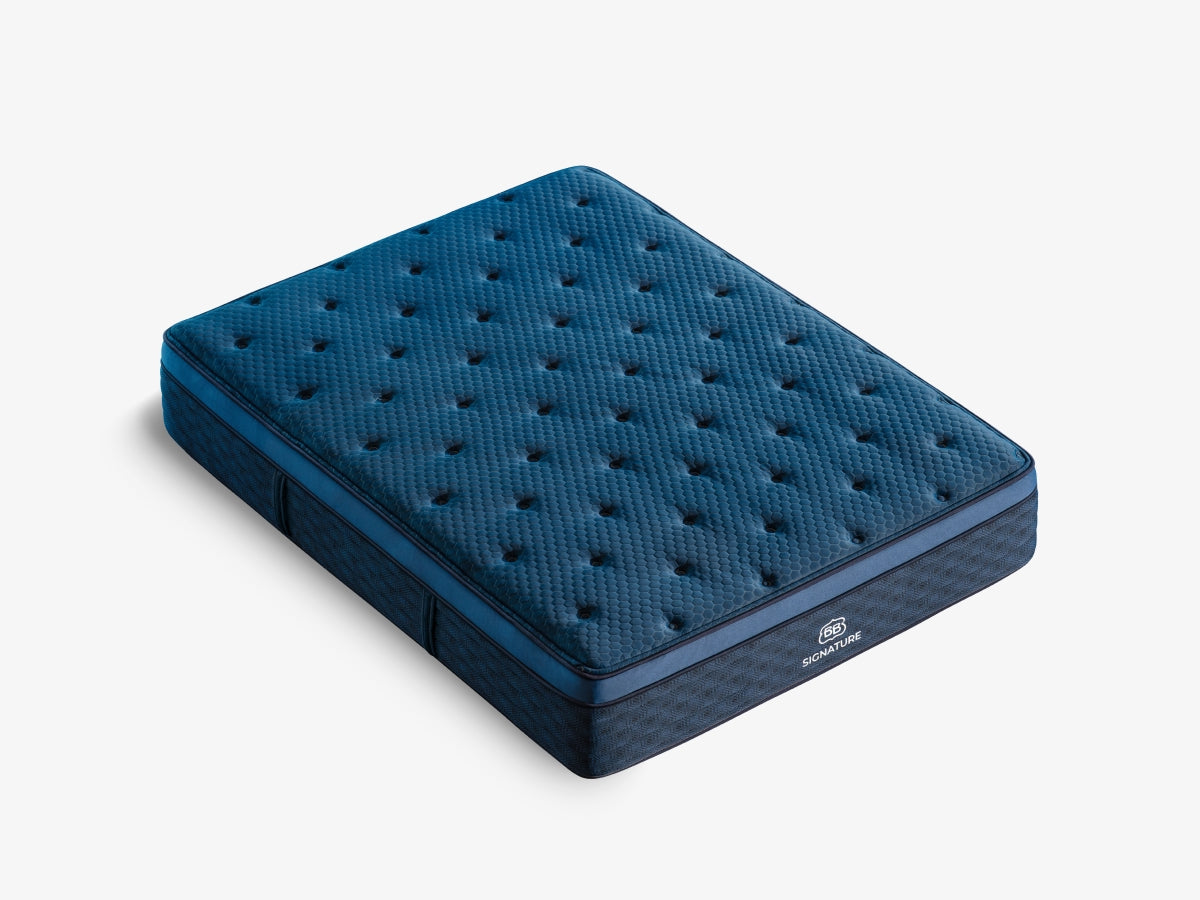
Brooklyn Bedding currently lists up to 760 encased coils in the Signature Hybrid and identifies an eight-inch coil core. Saatva's Classic uses two coil units, including individually wrapped comfort coils above a steel support base. The category name does not tell you whether the mattress has one coil layer, two, or a separate microcoil layer.
Separate motion from bounce
Coils can add response, while foam layers can absorb some movement. Individually wrapped coils move more independently than a connected unit, but motion also depends on the comfort layers, coil design, bed size, base, and how sleepers move.
Do not assume every hybrid isolates motion better than every innerspring. A thick foam hybrid and a lightly upholstered hybrid will behave differently. Couples should compare partner disturbance, ease of repositioning, and usable width as separate questions.
Inspect the edge construction
A mattress may reinforce its perimeter with firmer coils, a foam rail, or another structure. Sealy's current Posturepedic Hybrid describes a coil edge, while Serta's current Perfect Sleeper Innerspring describes an extra-deep foam rail. Either category can use either approach.
Ask what creates the edge and whether it applies to every size and firmness. Edge design can affect sitting and sleeping near the perimeter, but a product diagram cannot predict how the edge will feel to every person.
Keep temperature claims in perspective
Open space around coils can allow air movement, but the sleeper is closest to the cover and comfort layers. Thick foam, quilting, protectors, sheets, room temperature, and personal factors can all influence the experience.
A hybrid is not automatically cooler because it has coils, and an innerspring is not automatically cooler because it may have less foam. Compare the complete top section and treat branded cooling language as a feature claim that needs product-specific evidence.
Check height, weight, and delivery
Hybrids often use several comfort layers over a coil core, but both categories span many profiles. Brooklyn Bedding currently lists the Signature Hybrid at 13.25 inches without its optional pillow top and 14 inches with it. Saatva lists several height choices for the Classic depending on the current configuration.
Confirm the finished mattress height, Queen weight, package dimensions, and delivery method. Add the base height before judging whether the bed will be easy to enter. A taller or heavier mattress is not automatically better, and it can be harder to rotate or move.
Verify the base instead of assuming
A hybrid and an innerspring may work with platforms, foundations, adjustable bases, or traditional frames, but compatibility is model-specific. The coil system does not eliminate requirements for a flat surface, center support, acceptable slat spacing, or weight capacity.
Read the current warranty and setup instructions before reusing an old base. Serta currently lists broad frame compatibility for its Perfect Sleeper Innerspring, but that statement does not establish the rules for another product.
Compare firmness within the model
Construction type does not set firmness. Brooklyn Bedding offers the Signature Hybrid in soft, medium, and firm options. Saatva offers the Classic in three firmness choices. Other models may have one fixed feel or pair firmness with a pillow-top upgrade.
Compare the exact option you would order, not the general model family. A showroom sample, online review, or retailer display may use a different firmness, height, generation, or top treatment.
Evaluate price through the full package
Neither label establishes value. Price can reflect comfort-layer materials, coil design, height, certifications, cover, delivery service, return logistics, and brand positioning. A simpler build can be the better purchase when it matches your priorities and has clear policies.
Compare the same size and firmness on the same date. Include delivery, setup, old-mattress removal, required foundation, return fees, and financing cost. Save the specifications and policies shown when you order.
Build a model-level comparison
Use the same fields for each finalist and leave unknown information blank. The goal is to replace a broad category contest with a documented product decision.
- Exact model, generation, size, firmness, height, and seller
- Cover, quilting, comfort materials, and layer thicknesses
- Coil type, height, gauge, count by size, zoning, and perimeter
- Mattress weight, package size, delivery, setup, and removal
- Base requirements and adjustable-base compatibility
- Trial, minimum use period, return fee, pickup method, and warranty
- Complete delivered price and dated source links
The practical answer
Choose a hybrid when the exact model's comfort layers and coil design create the combination you want at an acceptable price and ownership burden. Choose an innerspring when a particular spring-based model offers a better construction, profile, response, delivery plan, or value for your household.
Do not award the decision to the label. Compare the comfort system, coil unit, edge, motion, height, weight, base rules, firmness, policies, and total cost. The better choice is the documented mattress that fits your priorities, not the category with the more modern name.
Sources
- Better Sleep Council: Mattress Type Definitions
- Saatva: Classic Innerspring Construction and Options
- Brooklyn Bedding: Signature Hybrid Construction
- Brooklyn Bedding: Coil Systems Explained
- Sealy: Posturepedic Hybrid Construction
- Serta: Perfect Sleeper Innerspring Construction
Sources were reviewed for this article on November 7, 2026.